Yokohama University of Pharmacy RNA Biology Group Hidenori Tani
How long does
an RNA live?
Inside a cell, every RNA is made and then destroyed. We measure that time axis and use it to work out what long noncoding RNAs actually do — and how to turn them into medicines for diseases that have had none.
Exponential decay. The time it takes to fall by half is the half-life.
In 2012 we built BRIC-seq to measure it genome-wide.
Built up by
the research group.
Citation metrics from Google Scholar, 20 July 2026.
Research
Three places
we measure time.
Liver disease
Human and mouse genomes are about 99% identical, yet lncRNA expression and function diverge between them. That gap is our handle on what lncRNAs do in the liver.
Brain disease
Alzheimer's, Parkinson's, epilepsy. Some lncRNAs governing neural development are conserved across species, and we follow their dynamics in living tissue.
Machine learning
Large datasets hide patterns a person will miss. We predict interactions between lncRNAs and RNA-binding proteins to surface relationships nobody has reported.
lncRNA
RNA that never
becomes protein.
Longer than 200 nucleotides, never translated — and still running everything from gene expression to cell fate.
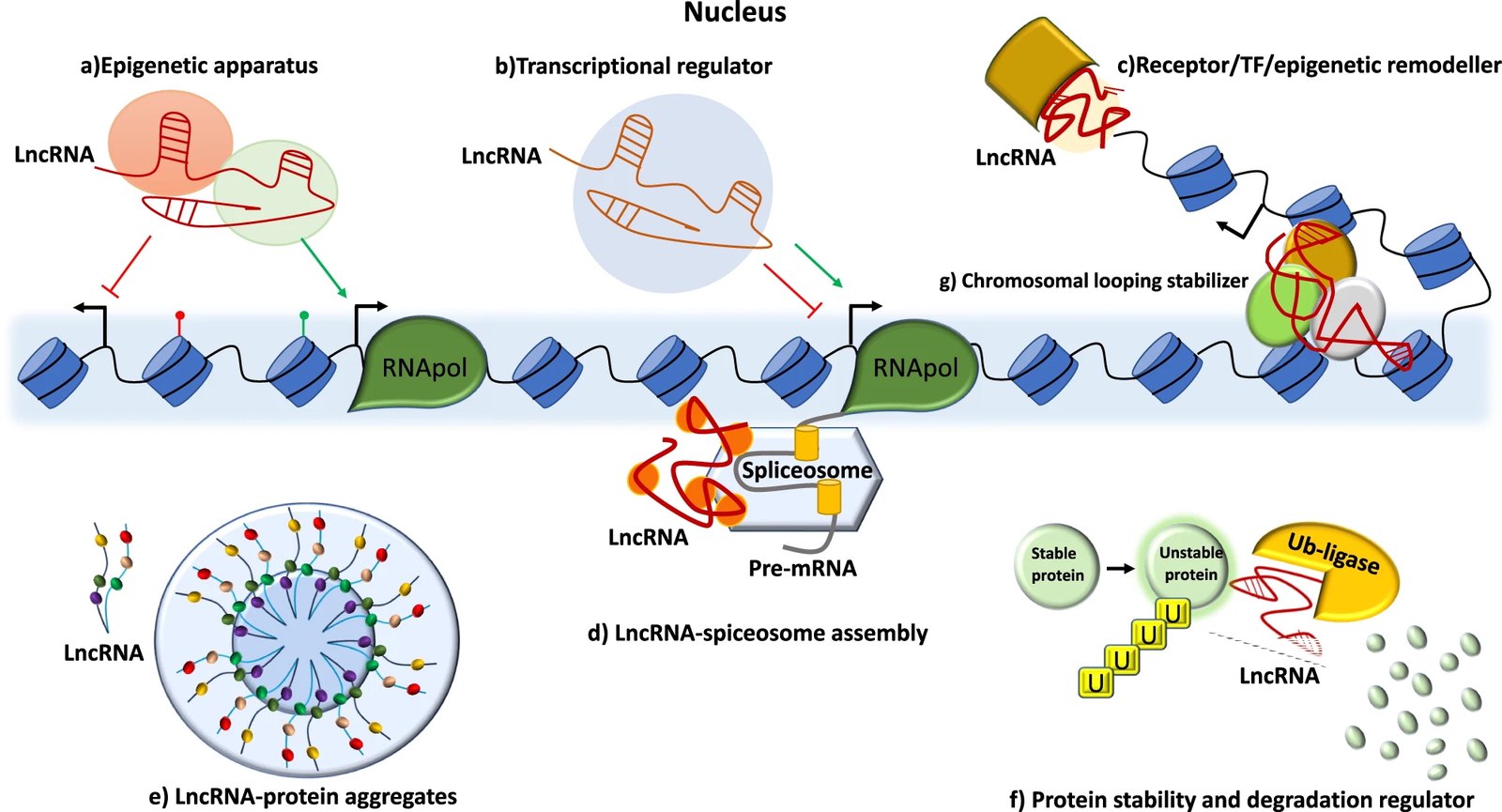
Figure from Cancer Gene Therapy, vol. 29, pp. 1866–1877 (2022)
Since HOTAIR was found in 2007, this field has not stopped surprising us. HOTAIR carries epigenetic control, NEAT1 builds and maintains paraspeckles, and MALAT1 acts on transcription and splicing.
Tens of thousands of lncRNAs are thought to exist. We work out their functions one at a time, map them onto disease, identify new therapeutic targets, and design drugs around the properties only lncRNAs have.
2026
Ten months
of output.
21 papers from the group.
-
2026.10.09
Trends in Biochemical Sciences
Beyond sequence: a half-life × localization framework for lncRNAs
-
2026.10.06
Ageing Research Reviews
Driver or Passenger? A Bradford Hill Framework for Aging-Associated lncRNAs
-
2026.10.05
Critical Reviews in Analytical Chemistry
Beyond the RNA census: a literature-derived measurement-claim framework for low-copy, transient, spatial, and native-state RNA analysis
-
2026.10.02
Chemico-Biological Interactions
The Coherence Response Index: predicted microRNA targets show no coherent regulation in chemically exposed mouse embryonic stem cells
-
2026.09.30
BioEssays
The partition code: how RNA modifications set the address of transcripts among membraneless compartments
-
2026.09.29
Biochemical Pharmacology
The expression window as a safety parameter for mRNA medicines
-
2026.09.26
Molecular Genetics and Genomics
The stability explanation for lncRNA discovery bias is not testable with current half-life coverage
-
2026.09.14
BBA – Gene Regulatory Mechanisms
Short-lived lncRNAs as candidate kinetic sensors of cellular stress
-
2026.09.10
Functional & Integrative Genomics
An lncRNA-aware single-cell framework with donor-level validation identifies reproducible MEG3 enrichment in human liver sinusoidal endothelial cells
-
2026.08.26
Molecular Genetics and Genomics
Codon optimality predicts mRNA half-life but does not transfer to lncRNAs
-
2026.08.25
WIREs RNA
The Hypothesis-Driven Loop: An Integrated Dry–Wet Framework for Long Noncoding RNA Functional Analysis
-
2026.08.20
Biotechnology Advances
Confound-aware lncRNA genomics: Separating biology from abundance, composition, and temporal artefacts
-
2026.08.19
Brain Research
A replicated astrocyte long non-coding RNA signature of Alzheimer's disease is inverted in amyotrophic lateral sclerosis
-
2026.08.18
Gene
RNA decay rate as a control point for long non-coding RNA function: a BRIC-based causal analysis of NEAT1
-
2026.08.13
Molecular Genetics and Genomics
Subcellular localization of human long non-coding RNAs is an isoform-resolved property masked by gene-level analysis
-
2026.07.24
Functional & Integrative Genomics
A single-cell cell-of-origin audit of the lncRNA RMST
-
2026.07.09
Journal of Molecular Biology
The Half-Life of a Mark: Dwell Time and the Missing Time Axis of the Epitranscriptome
-
2026.07.03
IUBMB Life
Half-life as a therapeutic design axis: targeting short-lived lncRNAs with antisense oligonucleotides
-
2026.07.01
Trends in Genetics
A blind spot in lncRNA discovery
-
2026.06.21
International Journal of Molecular Sciences
RNA-Binding Protein Occupancy Composition Predicts Long Noncoding RNA Subcellular Localization.
-
2026.06.11
BBA – Gene Regulatory Mechanisms
Short-lived versus long-lived lncRNAs: RNA stability as a determinant of regulatory function
Hidenori Tani, Ph.D.
Building the tools
that do the measuring.

As a fourth-year undergraduate in Satoshi Tsuneda's laboratory, I began research under Dr. Naohiro Noda at AIST. I was handed a problem three Ph.D. holders had spent six months on, and solved it with an idea that arrived on the walk home from a park. That became ABC-PCR, and it is when I decided to be a scientist.
In Nobuyoshi Akimitsu's laboratory at the University of Tokyo, I developed BRIC-seq and measured the decay rates of long noncoding RNAs genome-wide. That time axis has been at the centre of the work ever since.
At AIST I studied lncRNAs in human iPS cells. When COVID-19 arrived I added computational analysis to the wet-lab work. Since 2023 I have been at Yokohama University of Pharmacy, combining both with students.
Books
The same questions,
in book form.
Half-lives, decay, and the way time works on living things — written for readers outside the lab.









Let's collaborate.
601 Matano, Totsuka, Yokohama 245-0066, Japan
Yokohama University of Pharmacy